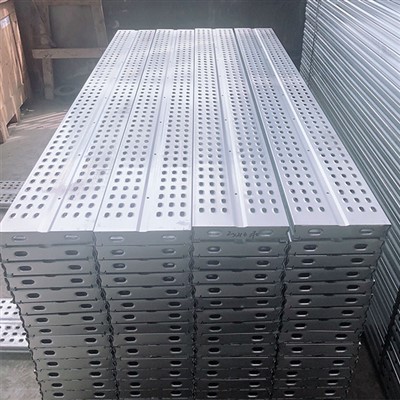
Hot-dip galvanized steel planks are key auxiliary construction equipment widely used in fields such as construction, shipbuilding, and chemical industry. Their correct use and maintenance are directly related to construction efficiency and operational safety.
Inspection and Preparation Before Use
Materials Inspection: Each steel plank should be checked individually before installation to ensure there are no serious deformations, cracks, or large-scale peeling of the galvanization layer. Planks that do not meet requirements should be promptly repaired or replaced.
Plan and Personnel: Before erection, an approved specialized construction plan should be in place. Installation and dismantling operations must be conducted by professionally trained and experienced personnel.
Safety Protection: Workers must wear safety helmets, safety belts, and other personal protective equipment correctly, and necessary protective measures such as safety nets and steel cables should be installed.
Installation and Laying Standards
Laying Principles: Steel planks should be fully laid, leveled, and stabilized, starting from one end of the scaffolding, with planks arranged in order.
Fixing Requirements
End Fixation: Steel planks at both ends of the scaffolding must be firmly fixed to the small crossbars of the scaffolding.
Middle Fixation: For flat and inclined paths, if hook-type or socket-type steel planks are used, they must be fixed to the small crossbars of the scaffolding every plank; if U-shaped clip connectors are used, fixation should occur approximately every 15 meters.
Overall Stability: When laying multiple planks, specialized scaffold fasteners or wire bindings should be used to ensure stable connections. If necessary, they can be reinforced by tying to the supporting steel pipes.
Inclined Path Laying
Anti-Slip Measures: Anti-slip measures must be taken on inclined paths. When transporting materials or using wheelbarrows, anti-slip strips should be added; for pedestrian access, lattice-type inclined ladders can be used.
Structural Standards: The width of pedestrian inclined paths should not be less than 1 meter, with a slope of 1:3. The width of material transport inclined paths should not be less than 1.5 meters, with a slope of 1:6. Platforms should be set at bends in inclined paths with a width not less than the path width. Railings 1.2 meters high and toe boards at least 180 millimeters high should be installed along both sides of the inclined path and around platforms.