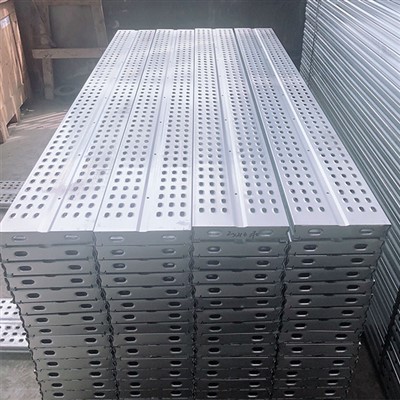
Galvanized steel planks are key components used in construction for laying work surfaces, offering multiple functions, mainly reflected in safety load-bearing, anti-slip drainage, durability, and efficiency.
Main Functions
Providing a Stable Work Platform
As scaffolding planks, they provide high-altitude workers with a flat, continuous, and non-slip surface for walking and operations, meeting the requirements of the "Technical Specifications for Safety in High-Altitude Construction" (JGJ80) that planks must be "fully laid, stable, and solid."
Strong Load-Bearing Capacity
Formed by stamping Q235 or Q345 steel, with a compressive strength of 250 MPa; can withstand a 2 kN concentrated load or a 6 kN uniformly distributed load, with deflection not greater than 15 mm/m, meeting high-strength construction requirements.
Anti-Slip and Drainage Design
The plank surface features anti-slip protruding holes or ribs to increase shoe sole friction, reducing the risk of slipping on rainy days. The underside is equipped with sand-draining holes (usually 3 Φ16mm) to prevent sand and water accumulation, keeping the surface clean.
Corrosion Resistance and Long Service Life
Hot-dip galvanized (zinc layer ≥ 80 μm), forming a dense zinc-iron alloy layer; in humid or high-salt environments (such as shipyards or power plants), it can last 6–8 years, far exceeding wooden or cold-galvanized planks.
Convenient Connection and Efficient Assembly
Both sides have M18 bolt holes for connecting planks, combined with 180 mm-high kickboards (black and yellow painted) to enhance overall platform stability. Some new models (e.g., patented by Yunnan Haojing) support quick-install curved plank replacement, compatible with various scaffolding types.
Lightweight and Easy to Handle
I-beam structure plus perforations reduces weight while maintaining strength, facilitating stacking, transportation, and repeated assembly and disassembly.