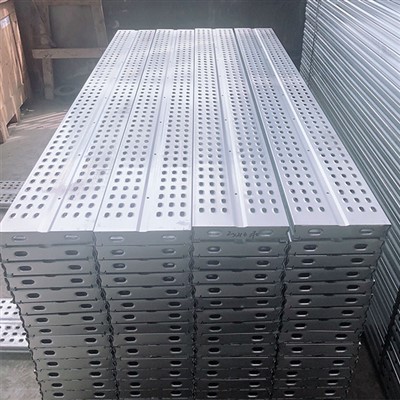
As a key temporary component used as a work platform in construction, the advantages of scaffolding planks vary depending on their material and design.
Steel Scaffolding Planks (including stamped and hot-dip galvanized types)
High Strength and Durability: Made of Q235 or Q345 steel, with excellent bending and torsion resistance. The service life can be more than 8 times that of wooden planks, suitable for high-rise buildings, bridges, and other high-load scenarios.
Excellent Slip Resistance: The surface is pressed with diamond patterns or perforated structures, combined with a hot-dip galvanized layer, providing good grip even on rainy days and improving construction safety.
Strong Corrosion Resistance: The hot-dip galvanized layer is thick (in accordance with GB/T 23457-2018 standard) and resistant to corrosion in humid and salt-spray environments; continuous use for 8 months has shown no rust.
Structural Stability: With hooks or flanged designs, they do not shift or produce noise once fixed on steel pipes. The probe length is standard (150mm), meeting JGJ130-2011 requirements.
Environmentally Friendly and Sustainable: Supports the "steel instead of wood" policy, reducing forest resource consumption, and aligns with national green building guidelines.
Bamboo Scaffolding Planks (Bamboo Mats, Bamboo Strips)
Low Cost and Abundant Material: Especially common in southern regions, costing only 1/3–1/2 of steel planks.
Lightweight and Easy to Install/Remove: Light in weight, suitable for small to medium projects or situations requiring frequent turnover.
Wooden Scaffolding Planks
Comfortable to Walk On and Easy to Lay: Traditionally common, providing comfort for workers, but usage has gradually decreased due to environmental policies.
Meets Standard Requirements: Board thickness ≥ 50mm, both ends reinforced with wire or iron plates, suitable for coupler-type steel tube scaffolds. ...